[LLM] Rubrics as Rewards: instance-specific rubric을 on-policy RL의 reward로 쓰기
[LLM] Rubrics as Rewards: Reinforcement Learning Beyond Verifiable Domains (RaR)
- paper: https://arxiv.org/pdf/2507.17746
- datasets: https://huggingface.co/datasets/anisha2102/RaR-Medicine , https://huggingface.co/datasets/anisha2102/RaR-Science
- ICLR 2026 accepted (인용수: 413회, ‘26-11-23 기준)
- 저자: Scale AI (Anisha Gunjal, Anthony Wang, Elaine Lau, Vaskar Nath, Yunzhong He, Bing Liu, Sean Hendryx)
- downstream task: 정답 검증이 어려운 expert reasoning 도메인(medicine, science)에서의 on-policy RL post-training
- rubric-based 평가(HealthBench)와 multiple-choice 평가(GPQA-Diamond) 모두에서 검증
- 주요 용어
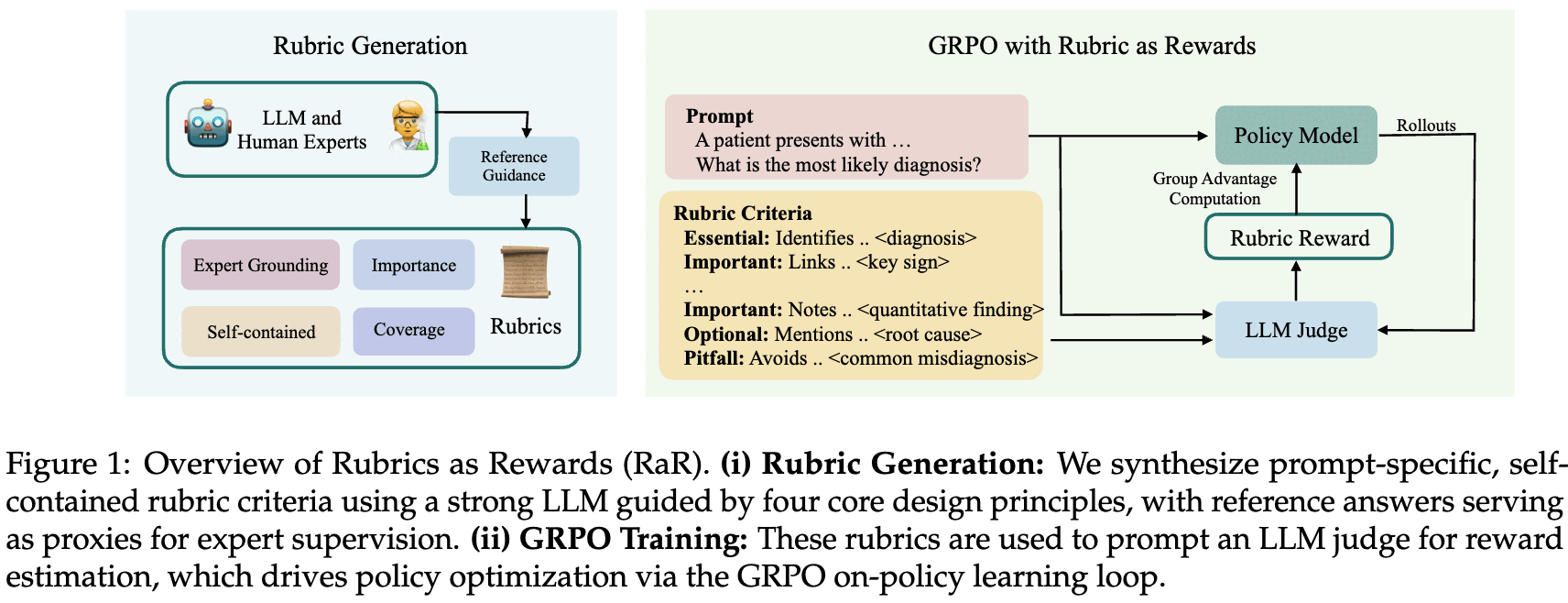
- Rubrics as Rewards (RaR): prompt마다 생성한 checklist형 rubric을 LLM judge에 넣어 reward를 계산하고, 이를 GRPO로 최적화하는 on-policy RL 프레임워크
- rubric item: prompt $x$ 마다 $k$개의 ${(w_j, c_j)}_{j=1}^k$. $w_j \in \mathbb{R}$ 는 가중치, $c_j:(x,\hat{y}) \mapsto {0,1}$ 은 응답이 해당 기준을 만족하는지의 binary 판정
- Explicit Aggregation: 기준마다 judge가 독립 판정 후 가중 평균 \(r(x,\hat{y}) = \frac{\sum_{j=1}^k w_j \cdot c_j(x,\hat{y})}{\sum_{j=1}^k w_j}\)
- Implicit Aggregation: rubric 전체(categorical label 포함)를 judge에게 한 번에 주고 1–10 Likert 점수 하나를 받음. $r_{\text{implicit}}(x,\hat{y}) = f_\phi(x,\hat{y},{d_j}_{j=1}^k)$ — 가중치 수동 튜닝 불필요
- Essential / Important / Optional / Pitfall: rubric 항목의 categorical label. Pitfall은 흔한 오답·누락을 잡는 negative criterion
1. Motivation
-
RLVR은 math/code처럼 정답이 자동 검증되는 태스크에서 강력함
- 그러나 의료·과학 같은 real-world reasoning은 정답 하나가 아니라 다기준(multi-criteria) 판단이 필요 $\to$ RLVR을 그대로 쓸 수 없음
-
대안인 preference-based reward model의 한계
- response length, formatting, annotator bias 같은 표면적 artifact에 overfit
- 대량의 pairwise comparison 데이터 필요
-
Instance-specific rubric은 이미 HealthBench 등 평가에는 쓰이고 있으나, on-policy 학습의 reward로 쓰는 연구는 거의 없음
$\to$ (Research Question) rubric을 checklist형 supervision으로 바꿔 RLVR의 단순함과 preference ranking의 표현력 사이 middle ground를 만들 수 있는가?
2. Contribution
- RaR 프레임워크: checklist형 rubric을 multi-criteria reward로 사용하는 on-policy RL 방법 제안
- 데이터셋 공개: instance-specific rubric이 포함된 RaR-Medicine (~20k), RaR-Science (~20k)
- 성능: rubric-scored(HealthBench)와 verifiable MCQ(GPQA-Diamond) 모두에서 Likert 기반 baseline 대비 일관된 향상
- Judge scale robustness: rubric을 주면 작은 judge도 human preference에 잘 정렬되고, judge 크기에 따른 편차가 줄어듦
3. Rubrics as Rewards
3.1 Problem Formulation
- 입력 prompt $x$, 응답 $\hat{y} \sim \pi_\theta(\cdot \mid x)$
- 각 prompt에 $k$개의 rubric item ${(w_j, c_j)}_{j=1}^k$ 부여 — 가중치 + binary correctness 함수
3.2 Reward Aggregation
- Explicit: 기준별 판정 $\to$ Eq.(1) 가중 정규화 합
- 정규화 덕분에 rubric 개수·가중치가 다른 prompt 간 reward 비교 가능
- 실험은 binary $c_j$ 이지만 continuous score로 확장 가능
- Implicit: rubric 리스트를 통째로 judge에게 넘겨 holistic 1–10 점수 $\to$ $[0,1]$ 정규화
- 가중치 설계를 judge에게 위임
3.3 RaR은 RLVR을 포함한다
- Remark 1: $k=1$, $w_1=1$, $c_1(x,\hat{y}) = \text{match}(y,\hat{y})$ 이면 RLVR과 동일 \(r_{\text{RLVR}}(x,\hat{y}) = \text{match}(y,\hat{y})\)
- 즉 RLVR = “essential criterion 하나짜리 rubric RL”의 특수 경우
- rubric은 여기에 다차원 supervision, 유연한 가중치, 주관/객관 기준의 결합을 추가
4. Rubric Generation
4.1 Desiderata (4가지 설계 원칙)
- Grounded in Expert Guidance: 정답에 필요한 핵심 사실·추론 단계·결론을 담을 것. 이상적으로는 human expert 또는 그 proxy(reference answer)에 근거
- Comprehensive Coverage: factual accuracy, logical coherence, completeness, style, safety 등 다차원 커버. 실수 잡는 pitfall 포함
- Criterion Importance: 기준 간 중요도 차이 반영 (e.g. factual correctness > stylistic clarity)
- Self-Contained Evaluation: 각 항목이 외부 맥락 없이 독립적으로 판정 가능해야 함
4.2 Rubrics Creation
- reference answer를 조건으로 LLM이 prompt당 7–20개 self-contained rubric 생성
- Medicine:
GPT-4o, Science:o3-mini
- Medicine:
- 각 항목은 numeric weight(1–5, pitfall은 −1/−2)와 categorical label을 모두 가지나, 실험에서는 categorical label(Essential/Important/Optional/Pitfall) 사용
- 데이터 통계 (Appendix)
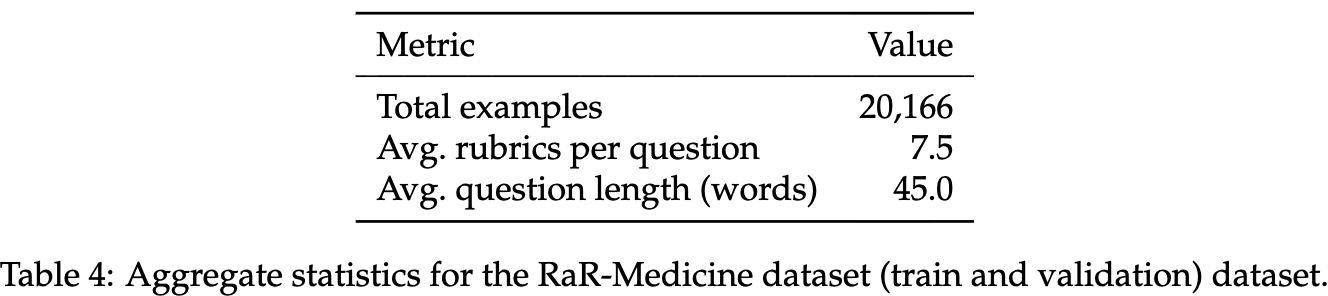
- RaR-Medicine: 20,166 examples, 평균 rubric 7.5개, 평균 질문 길이 45.0 words
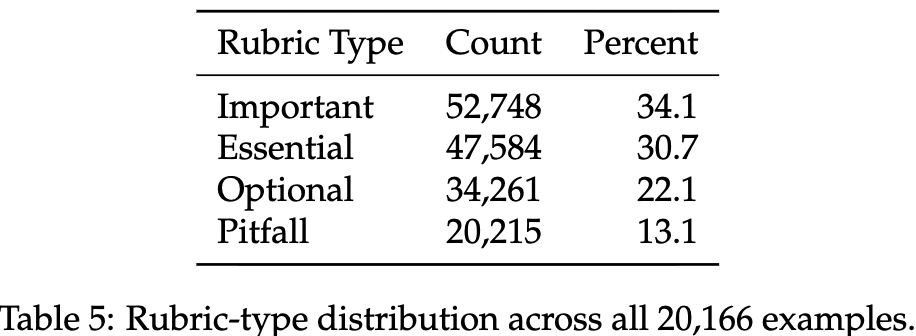
- label 분포: Important 34.1% / Essential 30.7% / Optional 22.1% / Pitfall 13.1%
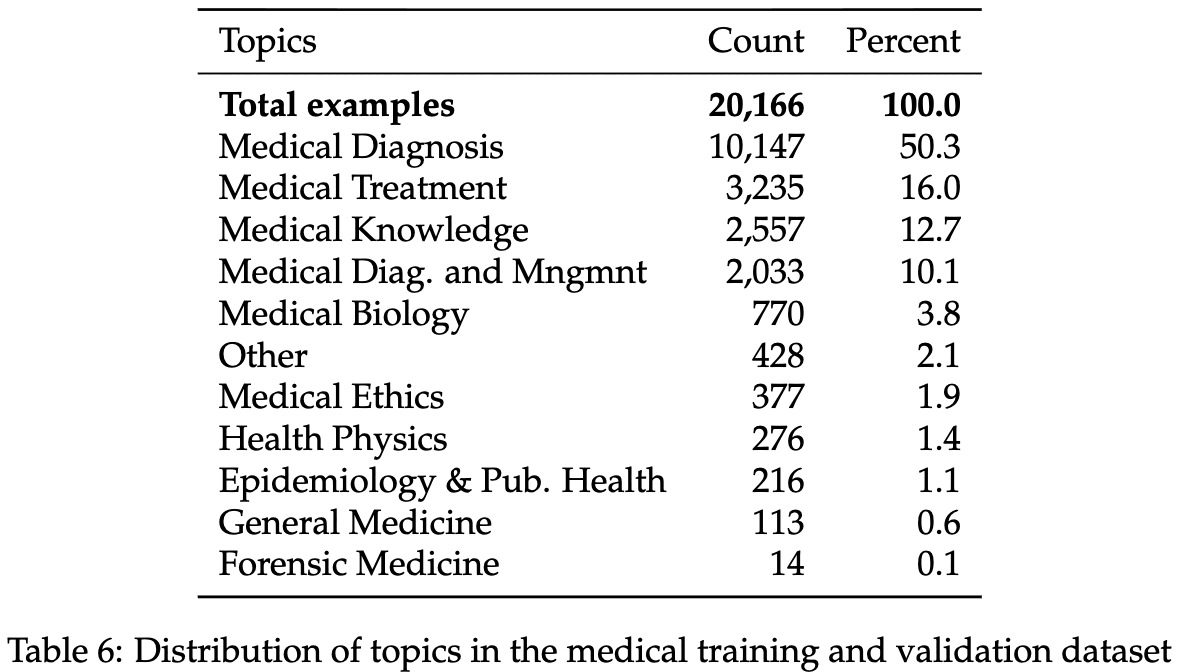
- 주제: Medical Diagnosis 50.3%, Treatment 16.0%, Knowledge 12.7% …
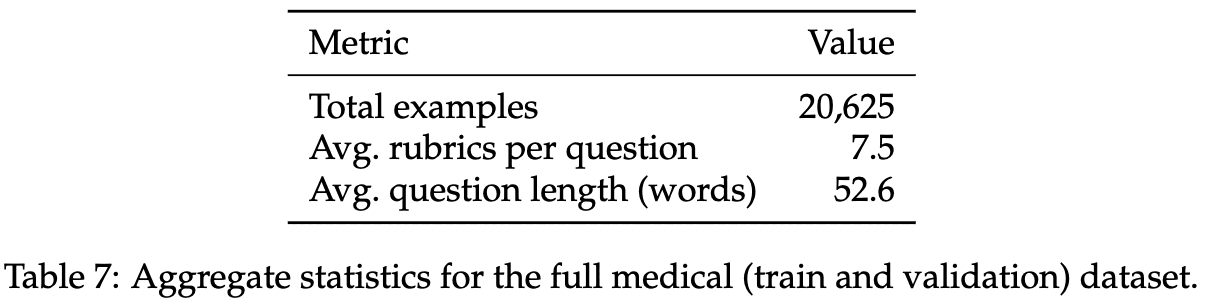
- RaR-Science: 20,625 examples, 평균 rubric 7.5개, 평균 질문 길이 52.6 words
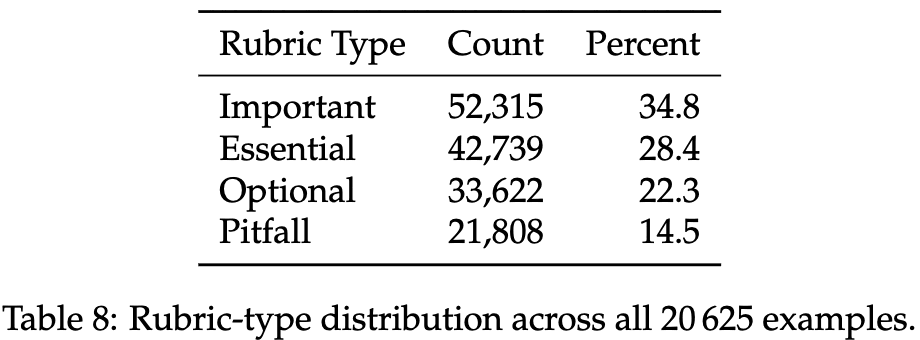
- label 분포: Important 34.8% / Essential 28.4% / Optional 22.3% / Pitfall 14.5%
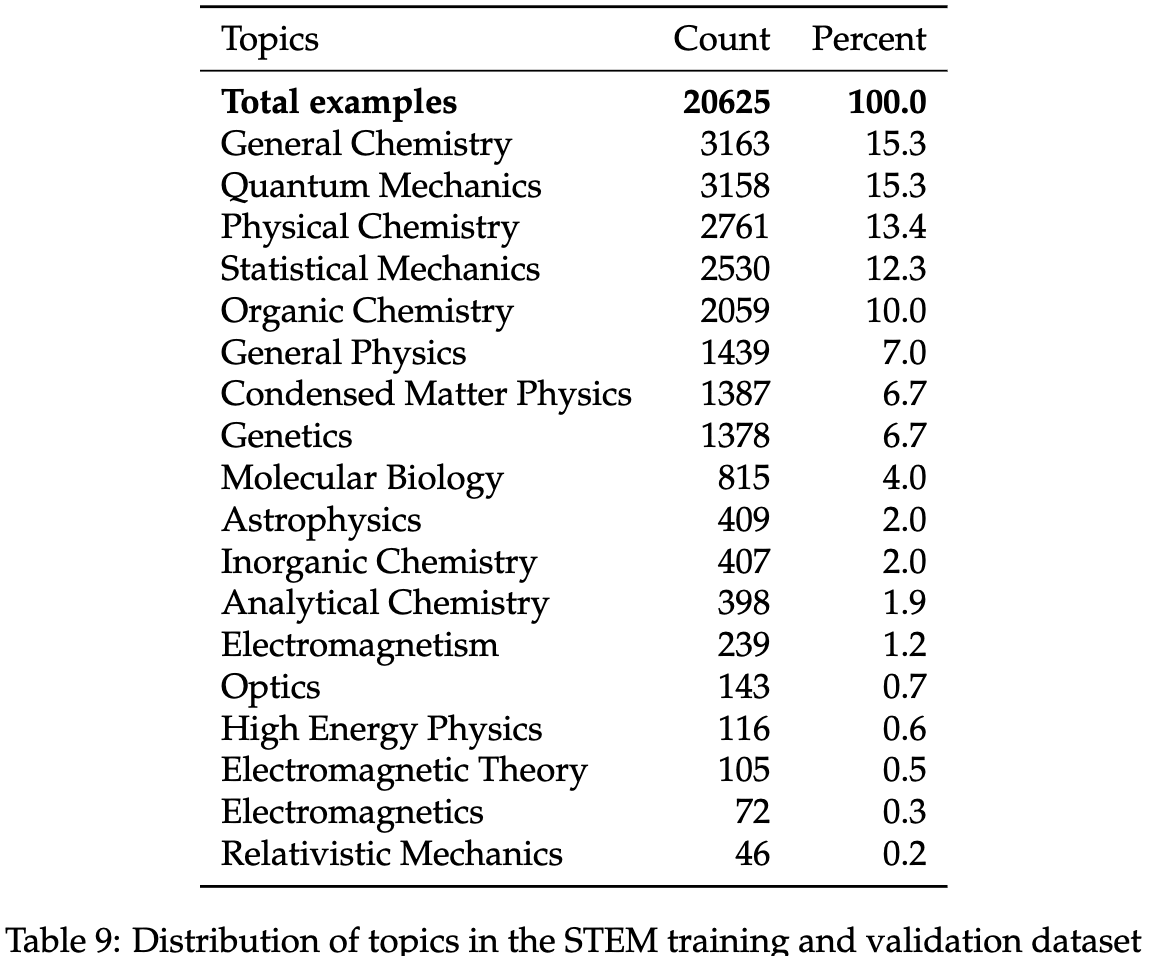
- GPQA-Diamond 카테고리에 맞춰 큐레이션 (General Chemistry 15.3%, Quantum Mechanics 15.3%, Physical Chemistry 13.4% …)
- RaR-Medicine: 20,166 examples, 평균 rubric 7.5개, 평균 질문 길이 45.0 words
5. Experimental Setup
5.1 Datasets & Training
- RaR-Medicine: medical-o1-reasoning-SFT, natural_reasoning, SCP-116K, GeneralThought-430K 등에서 20k prompt
- RaR-Science: natural_reasoning, SCP-116K, GeneralThought-430K에서 ~20k prompt
- Policy:
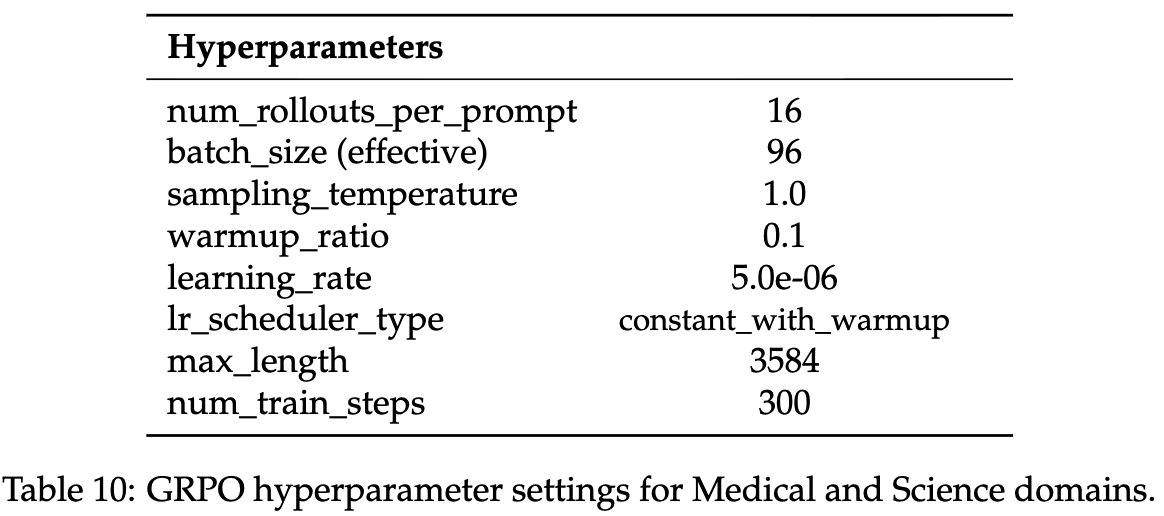
Qwen2.5-7Bbase, GRPO- rollouts/prompt 16, batch 96, lr $5\times10^{-6}$ (constant + 10% warmup), max length 3584, temperature 1.0, 300 steps
- 8×H100 단일 노드
- Judge:
gpt-4o-mini
5.2 Baselines
- Rubric-free
Off-the-shelf: Qwen2.5-7B, Qwen2.5-7B-InstructDirect-Likert: judge가 prompt–response만 보고 1–10 점수Reference-Likert: judge가 reference answer와 비교해 1–10 점수
- Rubric-guided
RaR-Predefined: 모든 prompt에 동일한 generic rubric 4개(정확성, 완결성, 간결성, 실용성), uniform weight + explicit aggregationRaR-Explicit: instance-specific rubric + explicit aggregation. 가중치 {Essential: 1.0, Important: 0.7, Optional: 0.3, Pitfall: 0.9}- pitfall은 “The response avoids misinformation” 처럼 positive로 phrasing $\to$ 만족 시 가점, 불만족 시 감점
RaR-Implicit: instance-specific rubric + implicit aggregation (1–10 Likert)
5.3 Evaluation
- Rubric-based: HealthBench (5,000 clinical conversations, physician-authored rubric), greedy decoding. ablation용으로 1,000개(HealthBench-1k) 분리
- Multiple-choice: GPQA-Diamond, greedy로 10회 run, 보기 순서 permute, boxed answer 파싱(실패 시 GPT-4o verifier), 95% CI 보고
- Judge alignment: HealthBench ~3,000 prompt에서 practitioner-approved 답(preferred) vs o3로 만든 perturbed 답 쌍 $\to$ pairwise preference accuracy
- 최종 3,027 preferred + 3,027 perturbed (총 6,054), perturbation은 manual screening으로 “객관적으로 더 나쁨” 확인
6. Experiments
6.1 Main Results
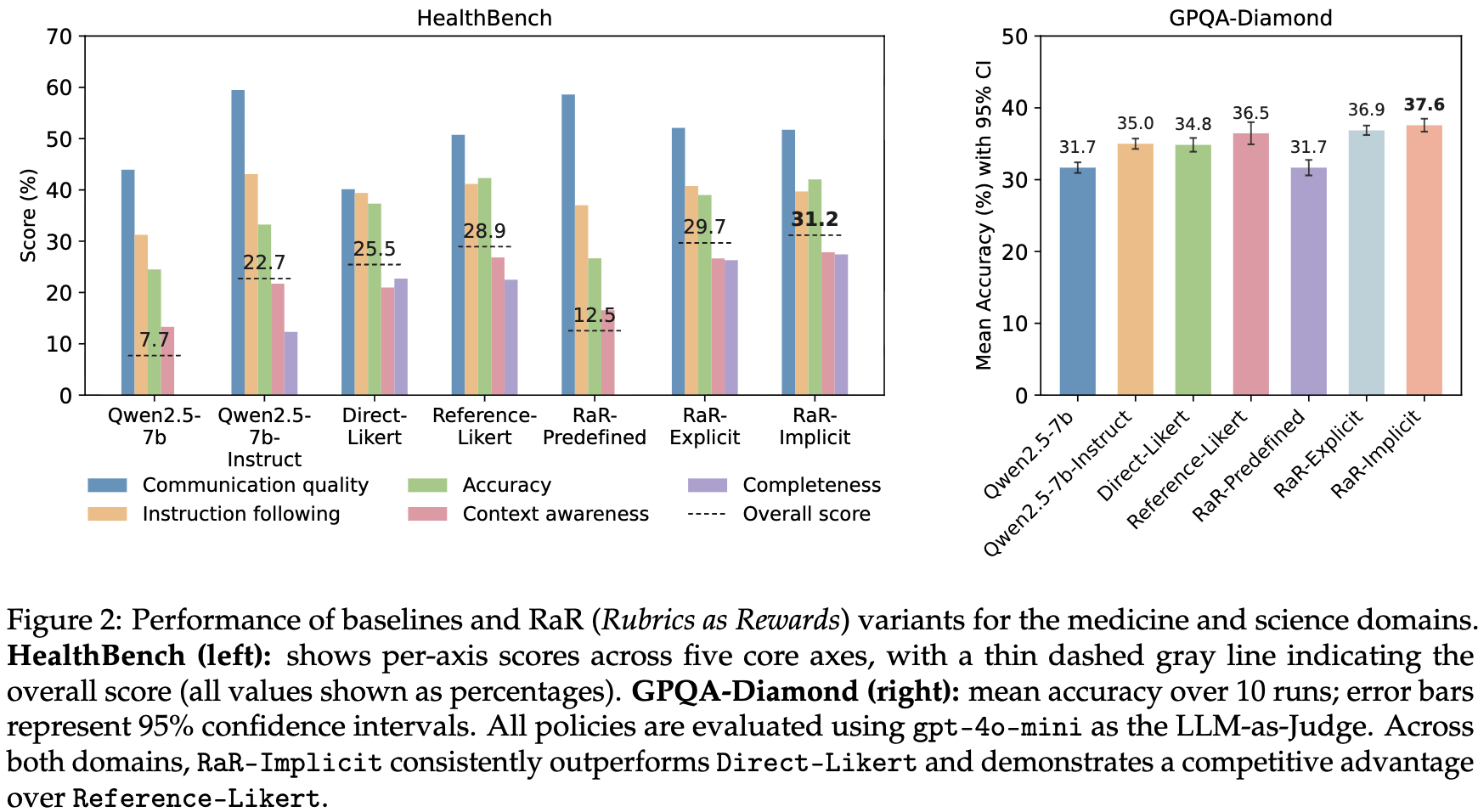
- RaR-Implicit이 전 도메인 최고
- Direct-Likert 대비: HealthBench 25.5 $\to$ 31.2 (+5.7pp), GPQA 34.8 $\to$ 37.6 (+2.8pp)
- 논문은 “relative gain up to 31% (HealthBench), 7% (GPQA)”라 서술하나, Figure 2 수치 기준 HealthBench 상대 향상은 약 22% — 수치/서술 간 불일치 있음
- 본문은 “Table 2 reports results”라고 쓰지만 실제로는 Figure 2를 가리킴
- rubric 학습 효과가 MCQ로도 일반화: rubric으로만 학습했는데 verifiable한 GPQA에서도 향상
- RaR-Predefined는 오히려 크게 하락 (HealthBench 12.5)
- generic criteria는 prompt-specific 요구사항·failure mode를 못 잡아 reward가 misaligned $\to$ instance-specific rubric 합성이 핵심
- Reference-Likert 대비도 소폭 우세 (28.9 $\to$ 31.2)
- rubric 자체가 reference answer로 만들어지므로 rubric 품질은 reference 품질에 묶임. 그래도 open-ended 답을 explicit criteria로 쪼개는 것이 더 잘 정렬된 신호를 줌
- Implicit vs Explicit: Implicit이 최고 성능, Explicit은 해석성·통제력은 높지만 가중치 튜닝이 brittle $\to$ 저자들은 application-dependent로 판단
6.2 Judge Alignment across Model Scales
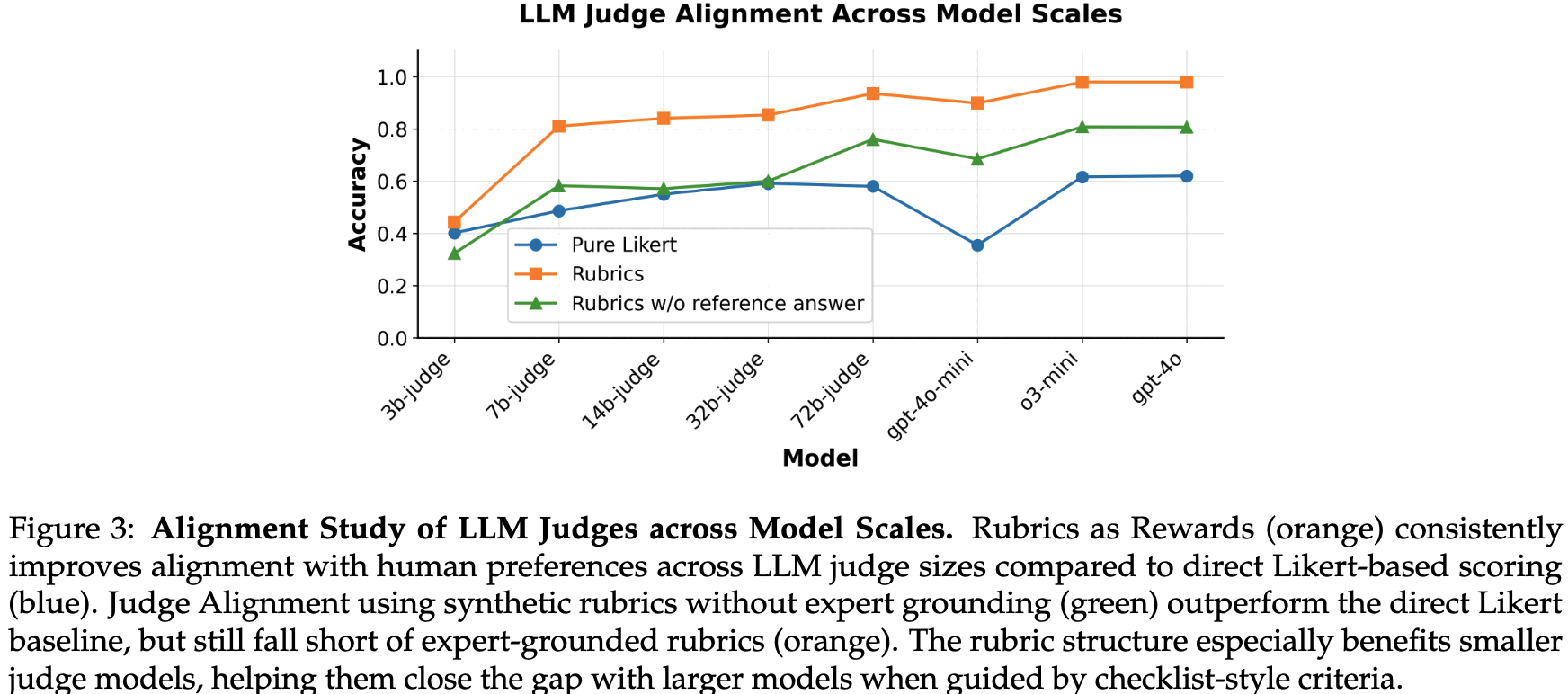
figure3 첨부 (judge 크기별 pairwise preference accuracy: Pure Likert vs Rubrics vs Rubrics w/o reference)
- 3B judge ~ gpt-4o까지 모든 judge 크기에서 Rubrics > Rubrics w/o reference > Pure Likert
- 작은 judge에서 이득이 가장 큼 $\to$ checklist형 기준이 small judge와 large judge의 격차를 좁힘
-
reference answer 없이 만든 rubric(green)은 Likert보다는 낫지만 expert-grounded rubric에는 못 미침 $\to$ expert guidance가 rubric 품질에 결정적
- Judge 품질이 GRPO 학습에 미치는 영향 (Appendix A.8)
- RaR-Implicit vs Direct-Likert: GPT-4o-mini 27.9 vs 25.3, Qwen-32B 26.2 vs 25.4, Qwen-14B 25.0 vs 24.9, Qwen-7B 26.7 vs 22.0
- 가장 큰 이득은 Qwen-7B judge (+4.7pp) — 가장 약한 judge를 큰 judge 수준으로 끌어올림
- rubric 기반 점수 분포가 더 좁음 (0.250–0.279 vs 0.220–0.254) $\to$ judge 간 일관성 향상
- 참고: 본문 Appendix 텍스트에는 “+0.047”로 표기되어 Table 11 차이(+4.7pp)와 단위만 다름
7. Ablations
7.1 Rubric 생성 전략 (Human vs Synthetic)
- HealthBench-1k를 hold-out, 나머지 3.5k prompt의 human-written rubric을 학습에 활용
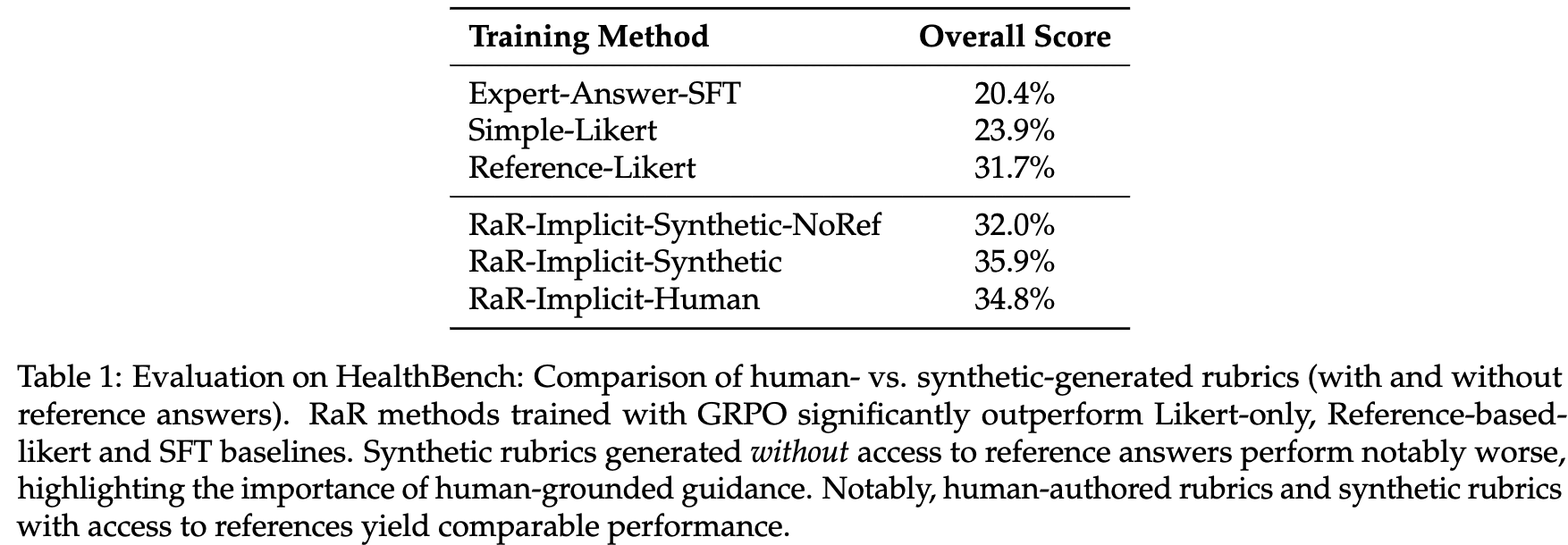
- 모든 instance-specific RaR 변형이 rubric-free baseline보다 우수 — 가장 약한 NoRef도 Reference-Likert 초과
- reference 기반 synthetic rubric (35.9) ≈ human rubric (34.8) $\to$ reference가 있으면 synthetic으로 충분
- reference 없는 synthetic rubric은 32.0으로 하락 $\to$ high-stakes 도메인에서 순수 synthetic rubric은 미묘한 기준을 놓침
7.2 Rubric 설계 요소
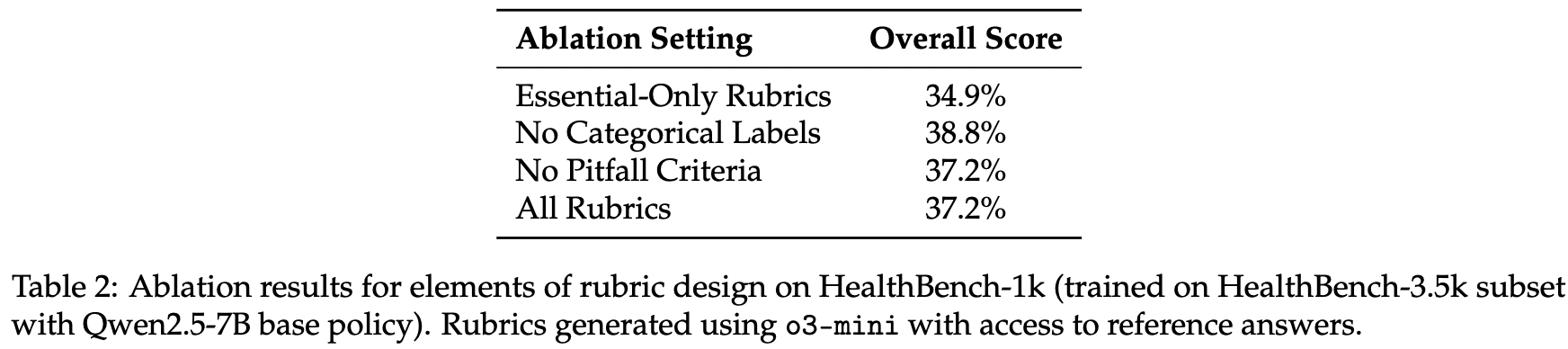
- 학습: HealthBench-3.5k, rubric은 o3-mini + reference
- Essential만 쓰면 하락 (34.9) $\to$ 더 넓은 범위의 criteria가 풍부한 학습 신호
- 가중치(label)·pitfall 유무는 영향 미미, 오히려 label 제거가 최고(38.8)
- 저자 해석: 효과적인 pitfall을 합성하려면 모델의 흔한 failure mode를 예측해야 하는데, 이는 human intuition이 필요한 어려운 작업 $\to$ synthetic negative criteria의 specificity 부족
7.3 Rubric 생성 LLM의 역량
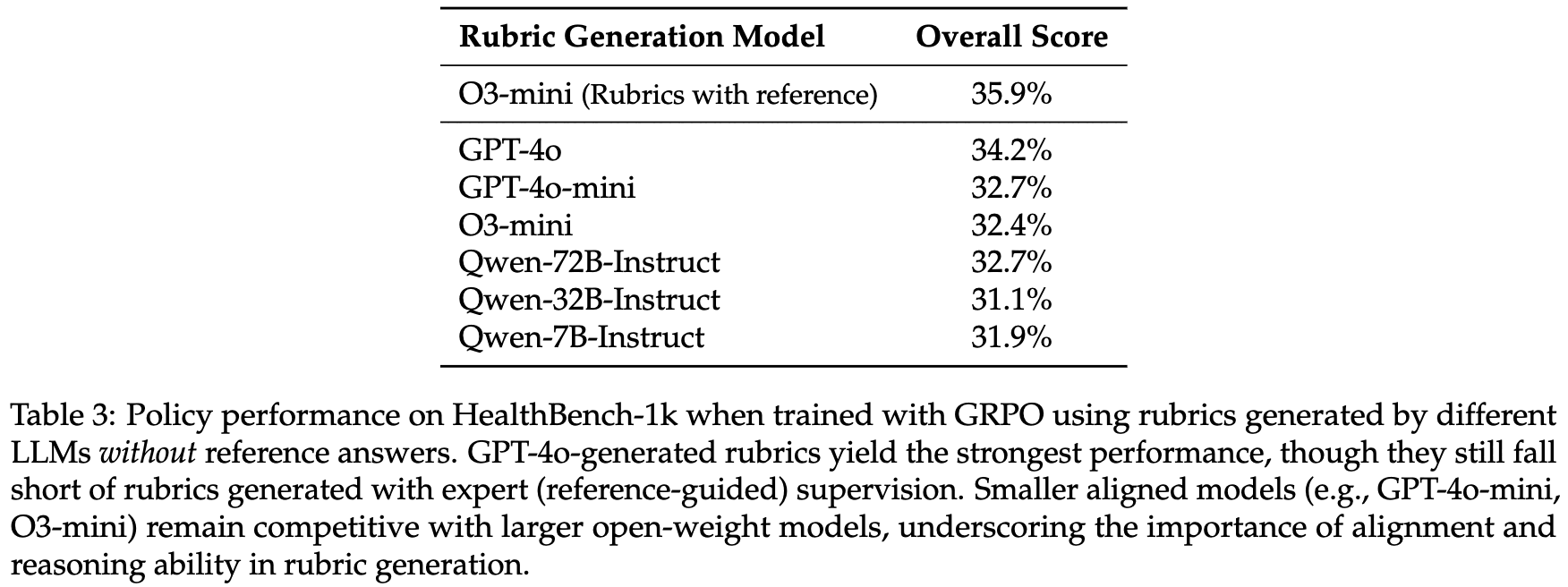
- reference 없이는 GPT-4o가 최고(34.2)지만 reference 있는 O3-mini(35.9)에 못 미침
- 작은 aligned 모델(GPT-4o-mini, O3-mini)이 큰 open-weight 모델과 비슷 $\to$ 크기보다 instruction tuning·reasoning 능력이 중요
8. Related Works
- RLVR across domains: General-Reasoner(200k mixed corpus, MMLU-Pro +10pt), Cross-Domain RLVR(single cross-domain RM), Med-RLVR(3B, MCQ clinical QA)
- Rubrics for evaluation/training: HealthBench(48k clinician criteria), rubric-prompted grader, CPT(rubric으로 DPO preference pair 생성), checklist 기반 preference tuning
- 기존 연구는 rubric을 채점 또는 preference data 생성에 사용 $\to$ RaR은 on-policy RL의 reward로 직접 사용
- Learning from feedback: RLHF(reward hacking), RLVR(sparse), PRM/ThinkPRM(annotation cost) $\to$ rubric은 다수 criteria를 structured verifier로 바꾼 denser reward라는 middle ground
9. Conclusion & Limitations
- Conclusion
- checklist형 rubric을 reward로 쓰는 RaR은 Likert 기반 baseline을 크게 넘고, reference-based reward와 동등 이상
- human preference alignment 개선 + 큰 judge 의존도 감소
- Limitations (저자 언급)
- 도메인이 medicine/science로 한정 — dialogue, tool use, agentic task 검증 필요
- aggregation은 implicit/explicit 두 가지만 탐색 — learned continuous weight나 curriculum형 dynamic weighting(초반 essential correctness $\to$ 후반 style/safety)은 미탐색
- judge는 off-the-shelf LLM만 사용 — 전용 evaluator / generative RM은 future work
- 추가로 보이는 한계
- policy가 Qwen2.5-7B 하나, judge도 메인 실험은 gpt-4o-mini 하나
- 본문 서술(relative gain 31%, Table 2 참조)과 Figure 2 수치가 맞지 않는 등 v2에도 정리 안 된 부분이 있음
- rubric 품질이 reference answer 품질에 종속 — reference 없는 도메인에서는 이득이 크게 줄어듦 (32.0 vs 35.9)
Takeaways
- RLVR은 “essential criterion 1개짜리 rubric RL”이다 — rubric은 RLVR의 자연스러운 일반화
- instance-specific이 핵심: generic rubric(RaR-Predefined)은 base 근처까지 무너짐
- 가중치 hand-tuning(Explicit)보다 rubric을 통째로 judge에 넘기는 Implicit이 더 잘 됨
- rubric 생성 시 reference answer 조건화가 가장 큰 레버 — 있으면 synthetic ≈ human
- rubric은 small judge를 large judge 수준으로 끌어올려 reward 비용 절감에 유리
- pitfall/label 같은 세부 설계는 synthetic으로 만들면 효과가 거의 없음 — negative criteria는 사람이 더 잘 만든다